
Frameworks · NSI · ERA · TCI
The Trust Condition Framework
Two ways of working, one diagnostic that tells you which you need
Developed by Links Global
What NSI and ERA are · The Trust Audit and TCI · The framework in pictures
Most communications strategy starts with the message. It assumes the people on the other end are willing to listen, weigh what they hear, and decide. Sometimes that is true. In a lot of places it is not, and the usual response, a sharper message pushed harder, makes things worse.
This framework starts one step earlier. It asks what an institution’s track record has taught people to expect, measures that as a Trust Condition Index, and only then decides what kind of work comes next. Where people are still open to a fair hearing, the work is message design. We call that Narrative Stewardship Infrastructure, or NSI. Where the record has closed the door, the work is repairing the conditions for a hearing before anyone drafts a talking point. We call that Epistemic Re-Regulation Architecture, or ERA.
What NSI and ERA Are
Narrative Stewardship Infrastructure (NSI)
NSI is an applied communications methodology for organizations that still have baseline credibility and need to manage a complicated public conversation well. It assumes constituencies are skeptical but open, and that a carefully built strategy can reach people who are genuinely weighing the question.
The core assumption is that the conditions for a fair hearing exist. The job is to design the message, its delivery, and its sequencing precisely enough to produce agreement rather than division.
NSI belongs in first-failure environments: organizations with intact credibility, and audiences whose opposition is about the proposal rather than the institution. It works on audience segments, message architecture, channel strategy, sentiment patterns, and crisis triggers. Its intervention point is the message and the infrastructure that carries it.
Epistemic Re-Regulation Architecture (ERA)
ERA is a framework for diagnosing and repairing public trust in places where an institution has disappointed people often enough that the community no longer approaches it in a deliberative frame. People have learned to expect the worst and to protect themselves accordingly. ERA works upstream of persuasion, on the conditions that decide whether any communications strategy can function at all.
The core assumption is that the conditions for a fair hearing may not exist. The job is to find out first, then build the prerequisites for deliberation before trying to communicate.
ERA belongs in chronic repeat-failure environments: institutions whose credibility has been worn down over years, and communities whose opposition is about the institution itself. It works on trust history, disclosure records, community expectations, local credibility networks, and patterns of civic participation. Its intervention point is everything that precedes the message.
ERA is explicit about what it knows and how well. Its scientific claims are tiered: established science, testable civic hypotheses, and threat intelligence that is used only to recognize manipulation, never to practice it. It also carries a firm ethical limit. ERA will not build manipulation tactics, manufactured trust signals, or engineered dependency for any client under any framing.
Traditional Strategic Communications vs. NSI vs. ERA
The traditional model
This is what most firms still sell and most internal teams still practice. Identify the message, find the audience, choose the channel, deliver, measure, adjust.
Its trust assumption is implicit and unexamined. It takes for granted that audiences are available to receive and evaluate what they are sent. Audiences are modeled as demographic segments or stakeholder categories, and the model stays static once drawn. Its evidence base is thin, drawing mostly on marketing tradition and practitioner instinct. Crisis response is reactive; the playbook gets written after the crisis starts. Measurement relies on lagging indicators such as likes, shares, reach, and sentiment scores after the fact. The ethical framework, where one exists, usually amounts to “don’t lie.”
The failure mode is predictable. In low-trust environments the traditional model produces diminishing returns, and when it is applied without a diagnosis it can speed up the collapse it was meant to stop. What it misses is simple: the same message, delivered with the same precision, lands very differently depending on the trust condition of the community receiving it. The model has no variable for trust history.
NSI
NSI is Links Global’s foundational methodology. It diagnoses audience trust conditions, segments constituencies, designs a narrative architecture for each segment, deploys predictive insight tools, phases messaging toward consensus, and keeps crisis governance ready throughout.
Its trust assumption is explicit. NSI checks whether baseline credibility exists before the strategy is designed. Audiences are mapped as dynamic, layered segments, each with its own narrative track, channel plan, and cadence. The map is kept alive rather than drawn once. The evidence base draws on behavioral science, sentiment analysis, network theory, and crisis communications research. Crisis response is proactive: the playbook is designed, documented, and rehearsed in advance. Measurement combines leading and lagging indicators, with predictive sentiment modeling before launch and outcome measurement after. Segmentation and message design serve genuine transparency, not manipulation.
NSI’s failure mode is the mirror image of the traditional model’s. It is not enough in chronic repeat-failure environments, where the trust it assumes has already been destroyed. Applied there, it can make things worse. What it adds over the traditional model is audience architecture, predictive insight, real-time adjustment, crisis-ready governance, and the recognition that communications is infrastructure, not a bulletin board.
ERA
ERA is Links Global’s framework for environments where trust has collapsed. It audits trust history and determines whether the institution is in a first-failure or chronic-failure condition. If chronic, it rebuilds predictability before any persuasion, distributes credibility through independent verification, demonstrates consistency in quiet periods, attaches falsifiable proof before the ask, and creates shared civic experiences with real consequences. Only then does NSI take over for the communications work.
Its trust assumption is radical in its plainness. ERA begins by asking whether the conditions for deliberation exist, and if they do not, it treats the communications work as not yet begun. Audiences are understood as trust networks rather than demographic segments: which local voices amplify credibility, which amplify distrust, and what the institution’s history with each of them looks like.
The science is formally tiered. Tier 1 rests on established work in stress and prefrontal function (Arnsten), reward prediction error (Schultz, Dayan, Montague), predictive processing (Friston), control and pattern perception (Whitson and Galinsky), and trust signaling (Zak and Kosfeld). Tier 2 holds the civic extrapolations that still need direct testing. Crisis response is structural: rebuilding the conditions under which crisis communication can be heard, which has to happen before the crisis. Measurement is longitudinal, tracking disclosure predictability, verification uptake, network diffusion, participation in shared experiences, and change in the trust condition over time, rather than campaign-cycle numbers. The ethical framework is published, three-tiered, and explicit about refusing to turn Tier 3 material into persuasion technique.
ERA’s failure mode is pace. It is slower than a messaging sprint, and it is the wrong tool for first-failure environments where NSI alone would do. What it adds over NSI is the diagnosis that precedes the diagnosis: the layer that tells you which tool to pick up before you pick up any.
The Trust Audit and the Trust Condition Index
How the Trust Audit is built
The Trust Audit is a mixed-methods diagnostic used before any communications or ERA work begins. It draws on five bodies of work:
- Procedural justice theory (Tyler), for measuring whether people experience institutional processes as fair, not just whether they like the outcomes
- Conflict analysis tools from Lederach and the Center for Justice and Peacebuilding: the Conflict Onion for positions, interests, and needs; the Conflict Tree for root causes and symptoms; the Power Cube for mapping where power sits
- Dugan’s Nested Theory, for placing a trust deficit in its wider system
- Predictive processing theory (Friston), for assessing how strong and how general a community’s defensive expectations have become
- Network theory, for tracing how trust and distrust travel through local social ties
The instrument draws a hard line between opinion and trust condition. It does not measure what people think about a policy. It measures what they have learned to expect from an institution, based on lived history.
The seven dimensions
1. Institutional history. The institution’s record of keeping promises, timing disclosures, and owning up to failure. Assessed through public records, meeting minutes, press coverage, community informant interviews, and a timeline of commitments made against commitments kept. Produces a reliability score across disclosure timing, delivery consistency, and self-reported failure.
2. Opposition characterization. Whether opposition is about the issue (NSI territory) or about the institution (ERA territory). Assessed through interviews with opposition voices, analysis of how opposition frames its language, and voting patterns where referendum data exists. Produces a classification: issue-specific, institution-specific, or hybrid, with the evidence behind it.
3. Defensive prior strength. How deeply and how broadly the community has come to expect harm from the institution. Assessed through structured interviews using the Conflict Onion, focus groups designed to surface expectations rather than opinions, and prior referendum data. Produces a rating of weak, moderate, strong, or entrenched for each constituency segment.
4. Network trust topology. Which local voices amplify the institution’s credibility, which amplify distrust, and how both travel through the community. Assessed through social network analysis where available, key informant identification, influence mapping, and media consumption patterns. Produces a trust network map with credibility hubs and distrust amplifiers marked.
5. Power space analysis. Where power actually sits in the community’s relationship with the institution, across visible, hidden, and invisible forms and across closed, invited, and claimed spaces. Assessed through stakeholder analysis, governance review, participation history, and patterns of exclusion. Produces a Power Cube map with the openings ERA can use.
6. Disclosure predictability. Whether the institution’s disclosure timing has been reliable or strategic, proactive or reactive. Assessed by lining up public disclosures against decision points, gathering community perception of timing, and comparing what was disclosed with what was withheld at key moments. Produces a predictability score and a pattern description.
7. Epistemic environment. The information ecosystem the institution’s communications have to move through: echo chambers, conspiracy prevalence, media health, algorithmic amplification. Assessed through media landscape and social content analysis, key informant interviews, and conspiracy prevalence mapping. Produces a rating of neutral, degraded, or severely degraded, with the specific threat patterns named.
The Trust Condition Index (TCI)
The Trust Audit runs at two depths, and each produces a Trust Condition Index that tells you which framework applies.
The Short Self-Assessment scores four dimensions on a 50-point scale: Institutional History (15 points), Opposition Characterization (15), Defensive Prior Strength (10), and Information Environment (10). It takes 20 to 30 minutes and is the version most organizations start with.
The Full Facilitated Audit scores six of the seven dimensions on a 65-point scale. Power Space is assessed qualitatively and shapes the design of ERA’s shared-experience work, but it is not scored.
The tiers below show the Short Self-Assessment range first and the Full Facilitated Audit range second.
Strong trust condition (40–50 short, 52–65 full). NSI alone. Baseline credibility is intact and a full communications strategy is appropriate.
Moderate trust condition (28–39 short, 37–51 full). NSI with ERA elements. Credibility is present but under strain. Add predictability-first disclosure and independent verification alongside the NSI work.
Low trust condition (16–27 short, 21–36 full). ERA first, NSI second. A chronic trust deficit is present, and ERA’s mechanisms need to be under way before any campaign is designed.
Severely degraded trust condition (10–15 short, 7–20 full). ERA only, on an extended timeline. Distrust is entrenched. Expect 12 to 24 months of ERA work before a communications campaign makes sense.
The number is not a grade. A low score is an honest reading of conditions many organizations are operating in and most communications programs were never designed to address. Its value is in what it tells you to do next.
The Framework in Pictures
Figure 1: The NSI architecture
Strategic communication
Audience architecture
Narrative sequencing
Messenger strategy
Digital technology and insight
Predictive sentiment
Pre-launch risk mapping
Real-time monitoring
Programs and stewardship
Living roadmap
Low-drama consistency
Disclosure calendar
Partnerships and crisis governance
Independent credibility
Crisis response protocol
90-minute playbook
The four pillars and their operating sequence are set out in the NSI white paper. None gets built until the trust condition has been assessed.
Figure 2: The ERA model
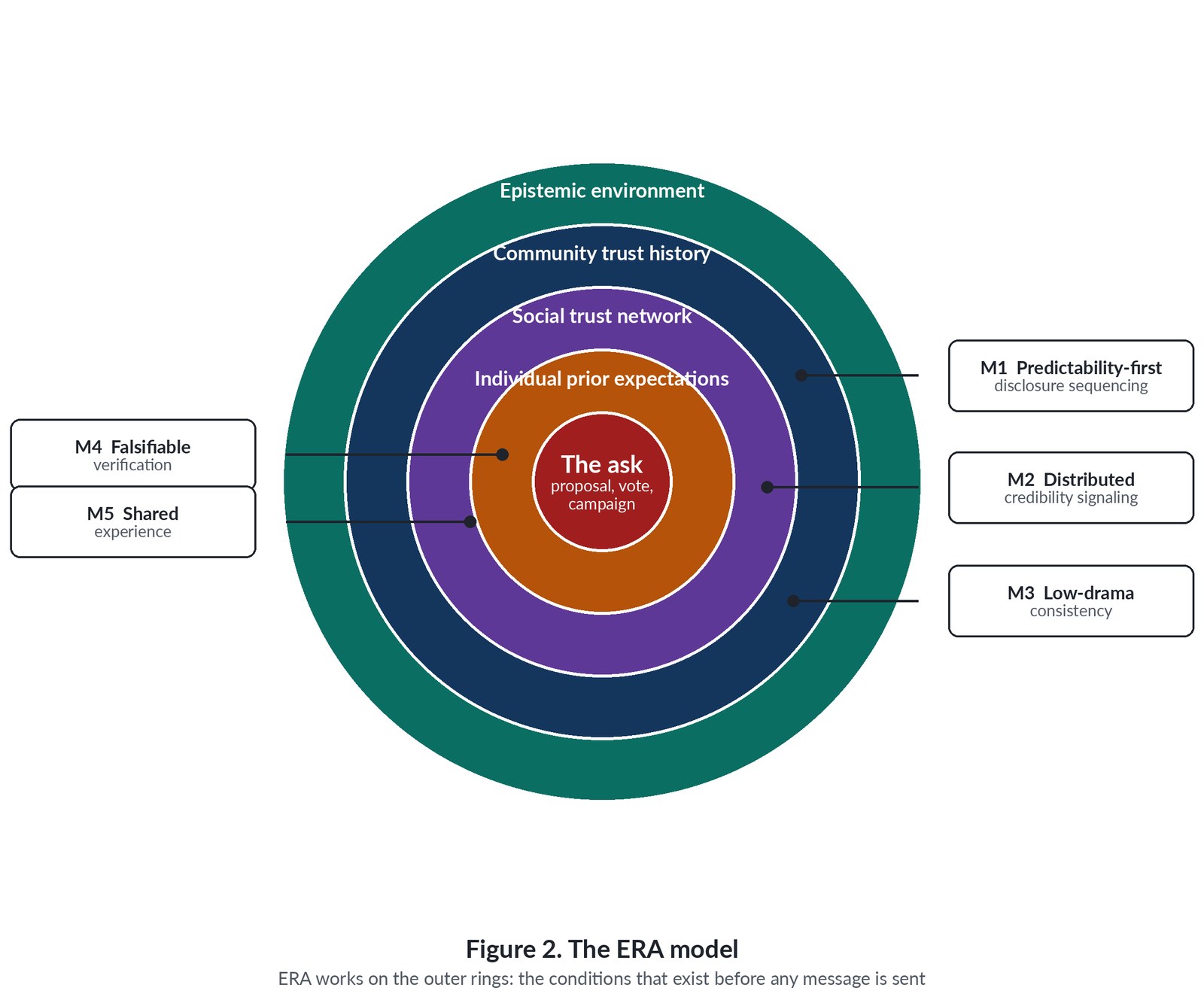
Adapted from Dugan’s Nested Theory. The ask sits at the center. Around it, from the inside out, are individual prior expectations, the social trust network, community trust history, and the wider epistemic environment. ERA’s five mechanisms map onto those rings: predictability-first disclosure sequencing and low-drama consistency work on community trust history; distributed credibility signaling works on the social trust network; falsifiable verification works on individual expectations; and shared experience works on both of the inner rings.
Figure 3: The NSI/ERA decision tree
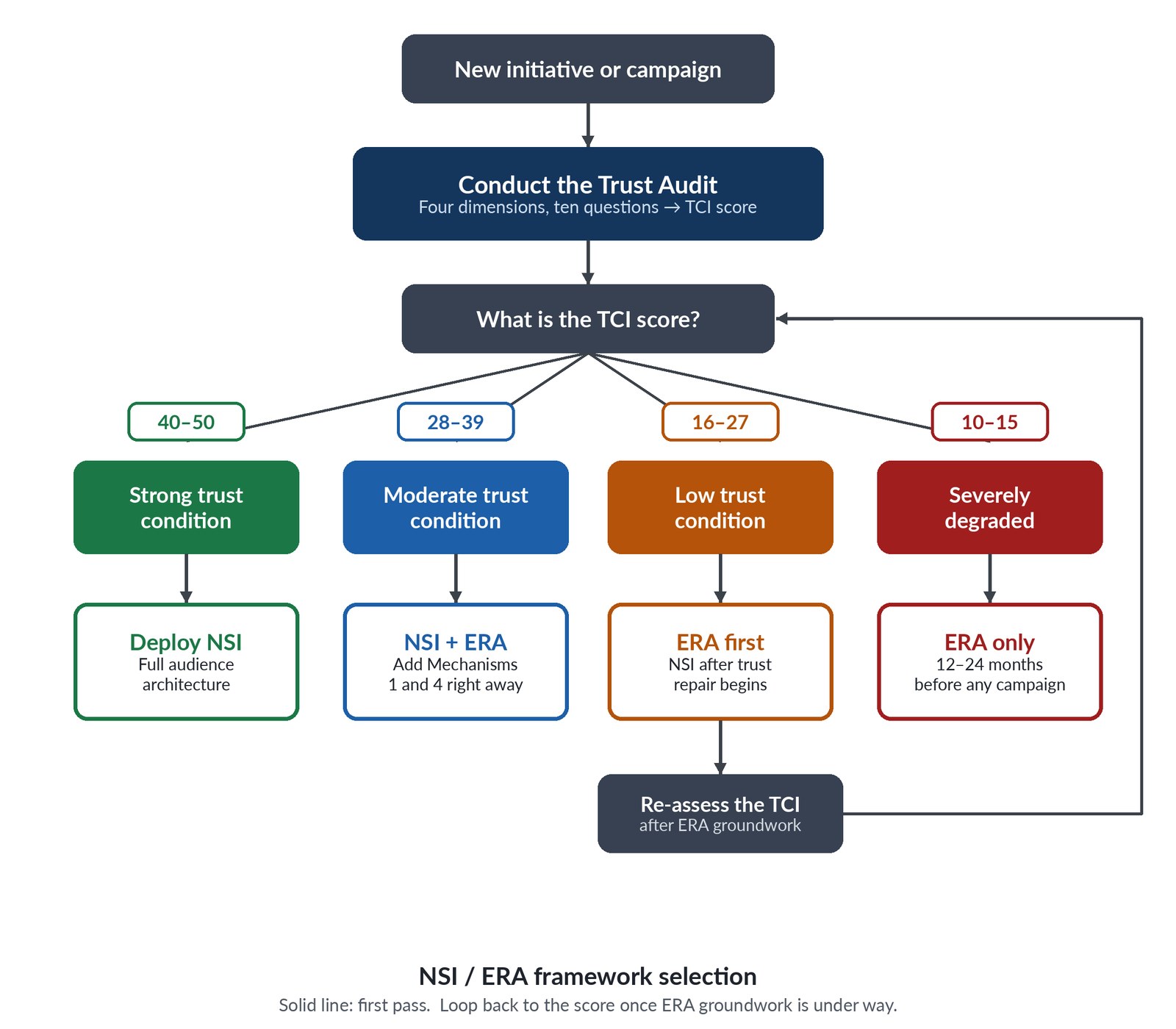
A new initiative triggers the Trust Audit. A TCI of 28 or above on the Short Self-Assessment routes to NSI, with ERA elements added in the moderate band. A TCI of 27 or below routes to ERA first. Once ERA groundwork is under way, the trust condition is reassessed, and NSI begins when the score crosses 28.
Figure 4: Traditional vs. NSI vs. ERA
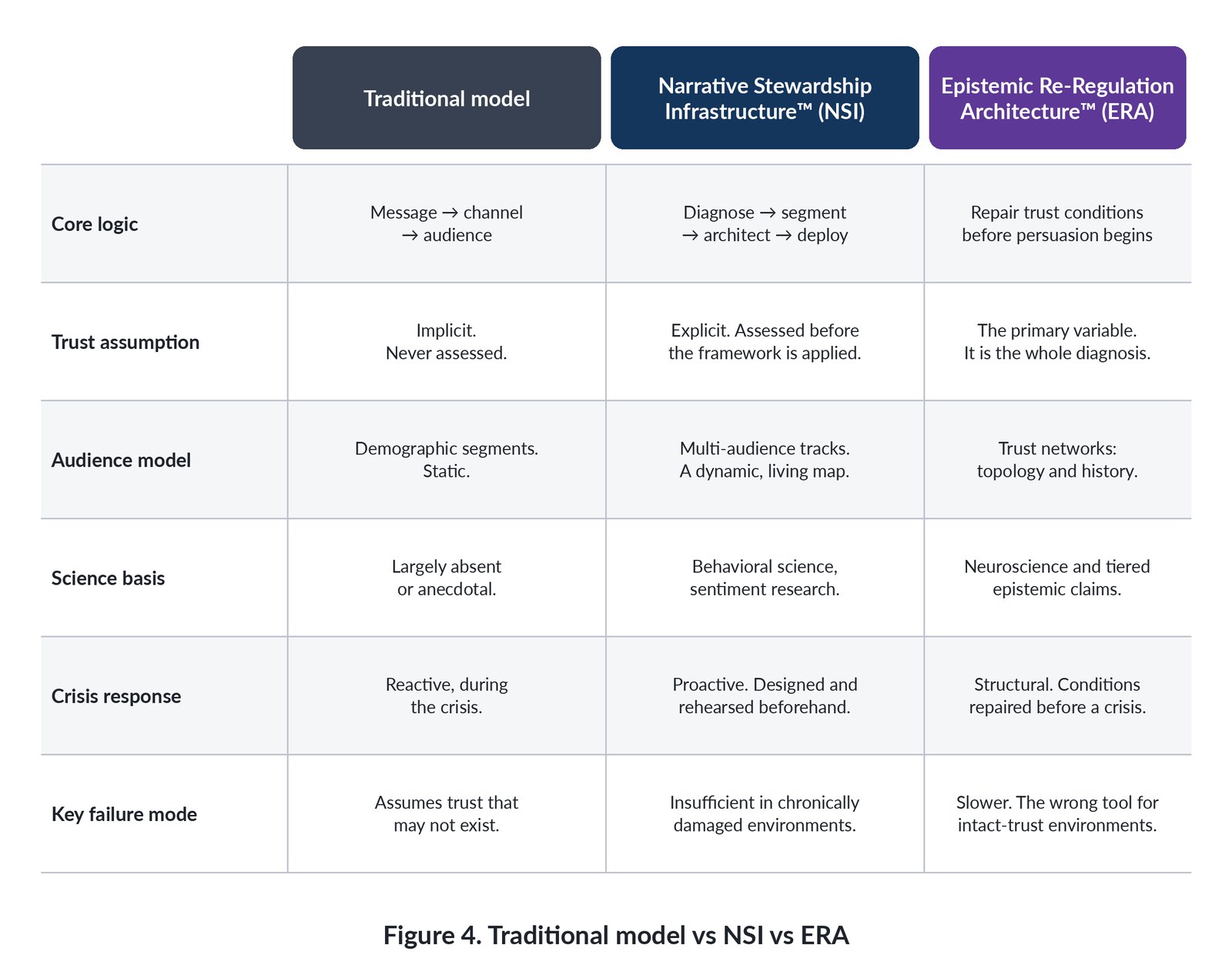
The three approaches compared on core logic, trust assumption, audience model, science basis, crisis response, and the way each one fails.
Figure 5: The trust condition iceberg
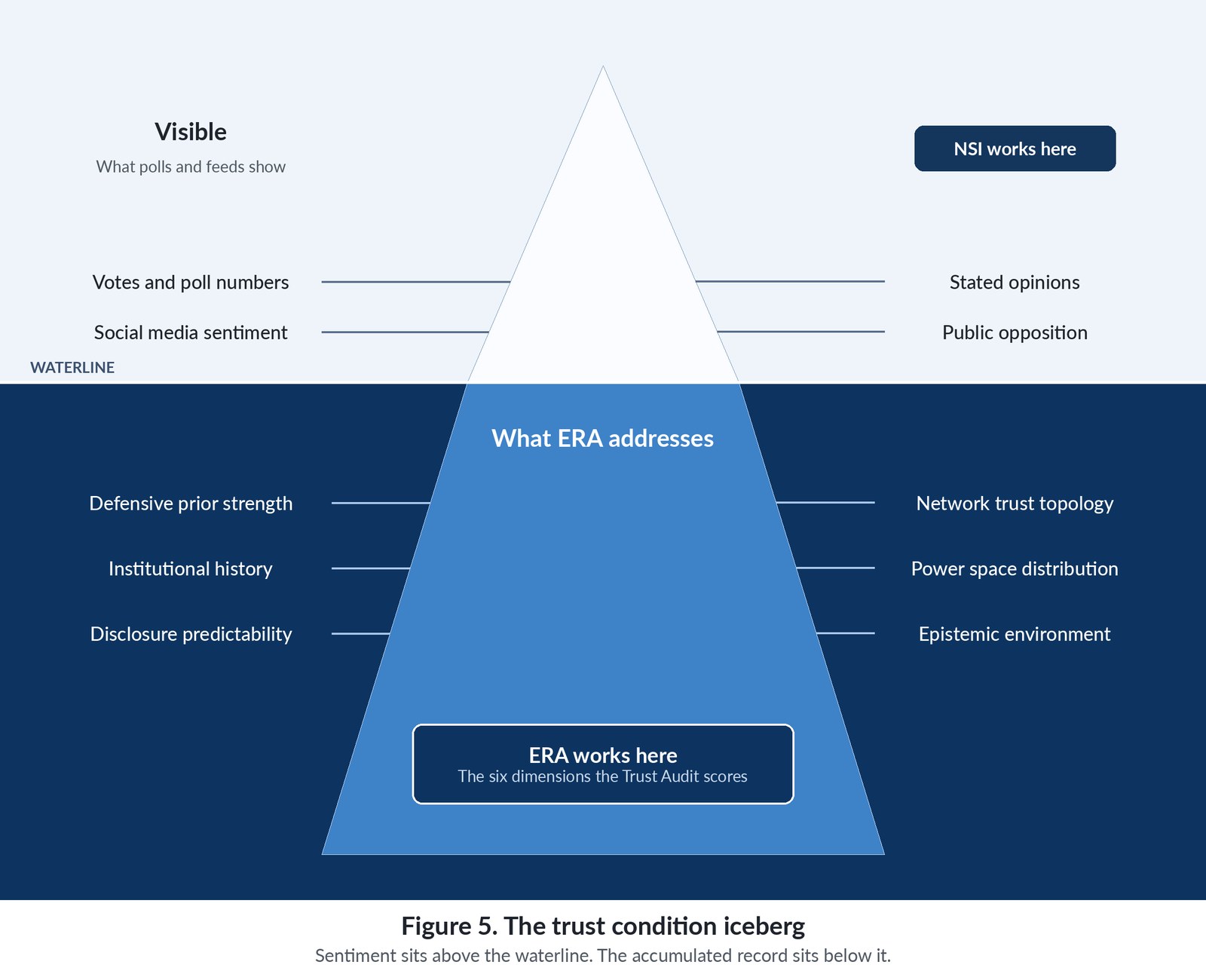
Above the waterline are the things that get measured every day: votes, poll numbers, social media sentiment, stated opinions, public opposition. Below it are the six dimensions the Trust Audit scores: defensive prior strength, institutional history, disclosure predictability, network trust topology, power space distribution, and the health of the epistemic environment. NSI works at and above the waterline. ERA works below it.
Where to Go Next
- Read the NSI white paper. Communications Is Infrastructure sets out the four pillars and the seven-step operating sequence.
- Read the ERA white paper. The Ask Is Not the Problem sets out the diagnosis, the five mechanisms and the evidence behind them.
- Take the Trust Diagnostic. The Short Self-Assessment takes 20 to 30 minutes and gives you your Trust Condition Index: The Links Global Trust Audit.
- Learn to run it. The self-paced Trust Audit Practitioner Course, eight modules plus an orientation, covers diagnosis, interpretation, and the conversation with leadership.
- Work with us. For a Full Facilitated Trust Audit, or an NSI or ERA engagement, contact Links Global.
Schedule a conversation with Links Global
Licensed edition
You are welcome to read the Trust Condition Framework here and to link to it. It is licensed material and is not offered as a download. To discuss use beyond reading, request a conversation.
Ownership and use terms
© 2026 Links Media, L.L.C. d/b/a Links Global. All rights reserved.
Internal use only. No resale, sublicensing, copying, adaptation, translation or teaching others. No use to train machine-learning models. Brief quotation is welcome with attribution to Links Global and a link to linksglobal.org. The ownership notice must stay intact.
Read the full Terms of Use · Version 1.0 · 9 October 2026