
Intel Vault · Case Study Library · Volume 1
The Majority That Wasn’t Enough
Links Global Case Study Library, Volume 1, Case 1: Lewiston, Idaho water infrastructure bond, May 2025. A case from the public record.
Case 1 of Volume 1 · From the public record · Retrospective reading, not a client engagement
The result
62 percent yes against a two-thirds threshold. About 150 votes short, on 18 percent turnout.
The reading
Moderate trust, one disclosure gap. NSI, plus a published commitment to release the traffic plan before the vote.
A Note on Volume 1
Volume 1 of the Links Global Case Study Library is different in kind from Volume 2. The Volume 2 cases come from inside Links Global’s own practice. The Volume 1 cases do not. Links Global did not work on the Lewiston bond, the Anderson County referendums, or California’s Proposition 3. No member of our staff advised any of the institutions, campaigns, or opposition groups involved, and we have no inside knowledge of how decisions were made. We selected these cases because they are well documented in the public domain. The vote counts, thresholds, ballot language, official statements, and press coverage are on the record and are cited here. They have been examined from many angles, as questions of fiscal policy, electoral politics, ballot design, and local journalism. To our knowledge they have not been read through a trust-condition lens, which is what we do here with the Trust Audit, NSI, and ERA.
Two consequences follow. First, every trust-condition estimate in this case is a retrospective reading from public evidence, not the result of a Trust Audit conducted with the institution. We give ranges, not scores, and we say where the evidence is thin. Second, the people who ran these efforts had information we do not. Where we describe what a different approach would have looked like, we are describing what the framework indicates, not judging the people who did the work. We welcome corrections from anyone closer to these cases.
| Initiative | $25 million general obligation bond to replace downtown water, wastewater, and stormwater infrastructure and reconstruct downtown streets |
| Jurisdiction and date | City of Lewiston, Idaho; May 20, 2025 |
| Approach used | Traditional communication: information sessions, media interviews, social media, website updates |
| Trust condition (estimated from public evidence) | Moderate to Low, roughly 24 to 32 on the 50-point Trust Condition Index |
| Outcome | Failed. 1,968 yes (62 percent) to 1,211 no (38 percent) against a required two-thirds supermajority, on about 18 percent turnout |
The Problem
Lewiston is a city of about 34,000 at the confluence of the Snake and Clearwater Rivers. Some of its water infrastructure is more than a century old, and the deterioration was documented. In May 2025 the city asked voters for a $25 million bond to replace sewer lines, water mains, and stormwater pipes and to reconstruct downtown streets. The need was real, the policy work was sound, and the city ran weeks of genuine outreach. (Spokesman-Review)
The city also made one consequential choice. A draft downtown traffic plan, unveiled the previous fall, proposed three roundabouts and a return to two-way traffic on parts of Main and D streets. Officials withdrew it before the vote and chose to finalize the traffic plan afterward. For residents and downtown businesses, that plan was the single most concrete expression of what the project would mean for their street, their commute, and their storefront.
The trust condition was stressed but not broken. The reservations on record were about the issue, not the institution. Lewiston had not been burned repeatedly. The more precise diagnosis is an information gap inside a moderately stressed trust environment: voters were willing to deliberate, and the information they most needed in order to do so had been held back.
The Result
On May 20, 2025, 1,968 voters said yes and 1,211 said no, about 62 percent to 38 percent, on roughly 18 percent turnout. Idaho requires a two-thirds supermajority for general obligation bonds, so the measure failed by about 4.7 points, or roughly 150 votes. (Spokesman-Review)
The failure point was not the majority that voted yes. It was the minority that held back, and why. The Spokesman-Review was careful to say it was unclear how much the missing traffic plan affected the vote, and we hold our reading as an inference. It is, however, the most precisely documented factor in the record, and it sits exactly where a trust-condition analysis would expect it. Withholding the operational detail that most directly affected daily life was experienced as management of information rather than transparency. In ERA terms, the city chose strategic surprise over disclosure reliability at the one moment when disclosure reliability mattered most. The city now faces a second campaign, more years of deferred maintenance, and the compounding cost of emergency repairs on pipes that do not wait for a re-vote.
[ THRESHOLD_GAUGE ] Lewiston, May 20, 2025
Short by
Roughly 150 votes
Yes share
1,968 of 3,179 votes cast
Turnout
As reported on this page
Drawn to scale from 0 to 100 percent of votes cast. Idaho requires a two-thirds supermajority for general obligation bonds. Figures as reported on this page.
The Solution
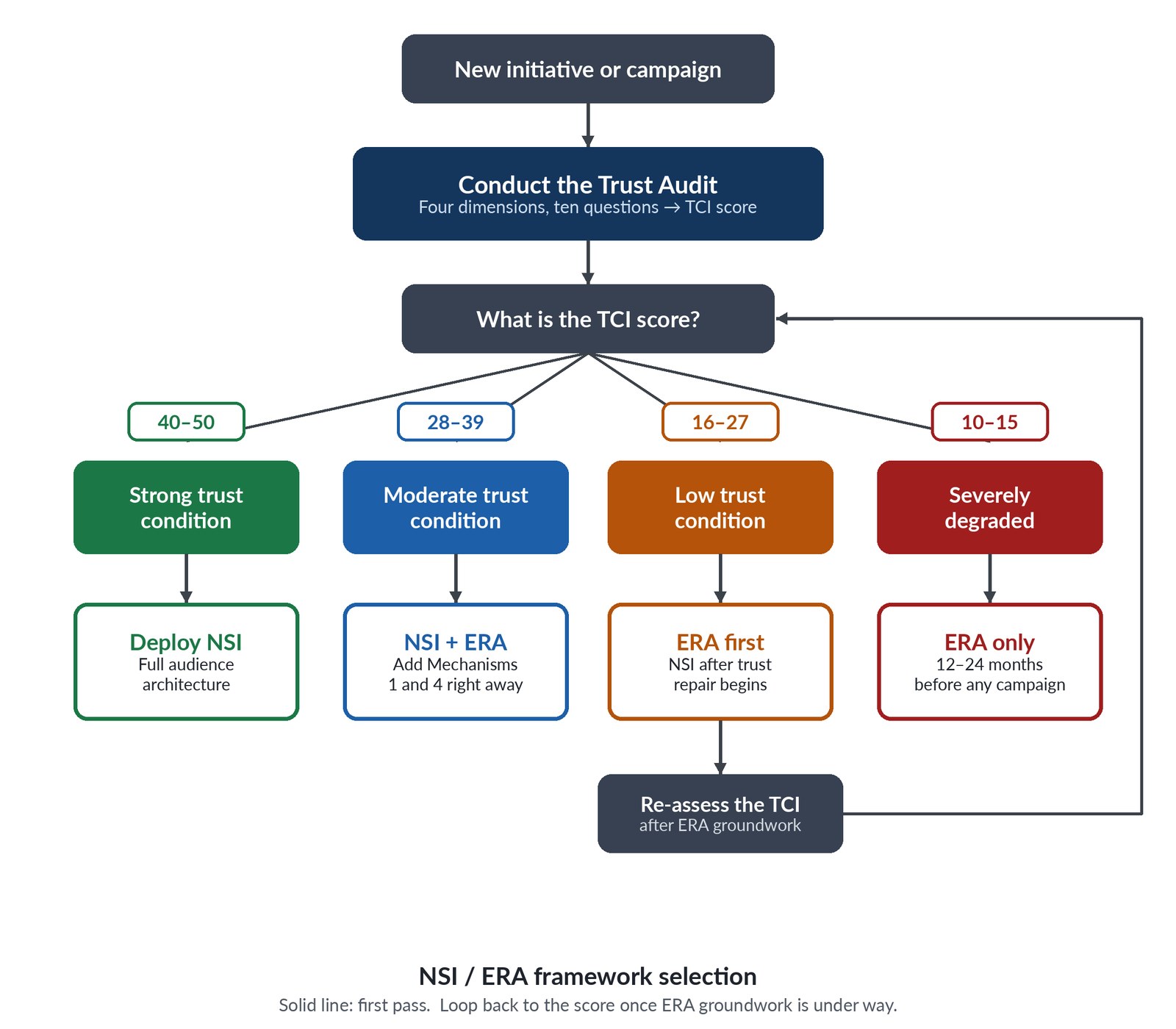
A Trust Audit before the campaign would have placed Lewiston in the Moderate band and flagged one predictable vulnerability: an unfinished operational plan for the project’s most visible component, being held pending the vote. The recommendation writes itself. Disclose before the campaign, not after.
NSI was the right primary framework. The audience was available. What was missing was a single ERA element, predictability-first disclosure: a published commitment to release the traffic plan before the vote, with a date and a named owner. In practice that means publishing the plan in draft months ahead, running a documented comment period with downtown business associations, publishing the final plan alongside the bond materials, and then running distinct NSI narrative tracks for residents (long-term savings and public health), downtown businesses (timeline, access, mitigation), and fiscal conservatives (bond cost against emergency repair escalation). The 150-vote gap is, in all likelihood, the downtown constituency that withheld support pending operational clarity.
The Lesson
A communications program that withholds the operational detail most consequential to the people being asked to vote is not a transparent program. It is a managed one. In a moderate trust environment, managed disclosure is often enough to lose the margin you needed.
Practitioner takeaway. Before any bond or referendum launches, ask for every constituency that must vote yes: what is the one piece of operational information this group needs in order to feel confident, and have we disclosed it? If it is being held pending the vote, pending finalization, or pending a more convenient moment, disclose it now. The cost of an uncomfortable detail before the vote is almost always lower than the cost of losing the vote because of it.
Sources
- Elaine Williams, “Voters reject infrastructure bond,” The Spokesman-Review, May 21, 2025. spokesman.com
All figures in this case are drawn from the public record cited above. The trust-condition estimate and the NSI/ERA reading are Links Global’s analysis.
Working With Links Global
This case is one of three in Volume 1, alongside The Hardening (Anderson County, South Carolina) and The Process Problem (California Proposition 3). The three sit at different points on the trust spectrum and call for different responses, which is the point of the library: the failures were not failures of effort or talent, they were failures of diagnosis. The Trust Condition Framework explains how the Trust Audit, NSI, and ERA fit together, and the Trust Audit Practitioner Course teaches the cases in sequence. If this case looks uncomfortably like a vote you are preparing for, that is a useful signal, and we are glad to talk it through.
Talk with Links Global about the case library
Copyright and Use
You are welcome to read this case, link to it, and quote brief passages with attribution to Links Global and a link to this page. Reproducing it in whole or in substantial part, adapting it, translating it, or using its analysis, structure, or framework reading in training, consulting, publications, or derivative works requires prior written permission from Links Global. Academic citation is encouraged; please cite as: Links Global (2026). The Majority That Wasn’t Enough: Lewiston, Idaho Water Infrastructure Bond (2025). Links Global Case Study Library, Volume 1, Case 1. www.linksglobal.org.