
Intel Vault · Case Study Library · Volume 2
The Mission Was Transformational. The Measurement Wasn’t.
Links Global Case Study Library, Volume 2, Case 1: a public healthcare replacement-facility communications program, anonymized.
Case 1 of Volume 2 · Anonymized by sector and year
The problem · The results · What we would add now · The lesson
By contract
Exceeded. On time, on budget, 13 million impressions, awards, contract extended, two referrals.
By our assessment
Excellent, and incomplete. Trust was never measured, so the effect on the institution’s most important asset remains unknown.
A Links Global case study from practice. Volume 2 cases are drawn from Links Global’s practice history since 2002, anonymized by sector and year. No client, organization, or individual is identified.
A Note on Volume 2
Volume 1 drew on the public record: bond elections and referendums with verifiable outcomes. Volume 2 cases are different in character and, in many ways, more instructive. They come from inside the work. These are engagements where the communications program was professionally executed, the metrics were met, the client was satisfied, and the contract was extended, and where the practitioner nevertheless left feeling that something essential had not been served. The gap, where there was one, was not in the execution. It was in what was measured, and what was left unmeasured.
These cases are offered as diagnostic opportunities, not confessions. Applied in retrospect, the Trust Audit, NSI, and ERA clarify what was happening structurally and what a more precisely instrumented approach would have added to work that was already good. They are also offered with honesty about the limits of hindsight. We cannot know what a different measurement framework would have surfaced. We can say, with confidence, what the trust condition of each environment likely was, and which indicators would have told us whether the work was moving the thing that matters most.
| Initiative | Three-year communications program for the transition and opening of a major public healthcare replacement facility: staff communications, community outreach, branding, media relations, multicultural engagement |
| Sector and period | Public healthcare; 2000s |
| Approach used | Traditional communication, comprehensively and professionally executed |
| Trust condition (estimated in retrospect) | Varied sharply by constituency, from roughly 10 to 38 on the 50-point index. No formal Trust Audit was conducted |
| Outcome by contract | Exceeded. Deliverables on time and on budget, media reach well past target, client satisfied, contract extended, two referrals, awards for broadcast work |
| Outcome by our assessment | Excellent by every available measure, and incomplete. Trust was never measured |
The Problem
A major urban public healthcare institution, the safety-net provider for a large, historically underserved population, had completed a replacement facility after years of planning. This was not a routine move. The new building was technologically current, and it offered several transformations at once: a chance to change how a community related to an institution long stigmatized as the place of last resort; a chance to attract privately insured patients who had never considered it; a chance to redirect inappropriate emergency department use toward a new network of community clinics; and a chance to move an entire clinical and administrative workforce into a new way of working and a new institutional identity.
The communications challenge was proportional. The institution had to move an established workforce out of spaces they had adapted and made their own over years. It had to inform, reassure, and redirect a patient population that was predominantly low-income, uninsured or underinsured, multilingual, and historically disengaged from institutional health systems. It had to work in a media environment that had covered the institution mainly through its problems, under the oversight of elected officials whose relationship with the institution was politically complex, and across many language communities.
Underneath all of that sat five or six distinct trust environments, each needing its own diagnosis. In retrospect, clinical staff sat in the stressed-to-damaged range (roughly 22 to 32), carrying years of promises about the new facility that had been made, adjusted, and delayed. The patient population sat lower still (roughly 10 to 22); many knew the institution only through its emergency department, and for a significant share of them the premise that a campaign message would be received as information to be weighed was uncertain. Local media was in a damaged, institution-specific relationship (roughly 15 to 25). Elected officials were mixed (roughly 28 to 38). Community organizations ranged from collaborative to adversarial depending on how the institution had handled past health crises (roughly 18 to 30).
[ TRUST_CONDITION_MAP ] Estimated in retrospect. No formal Trust Audit was conducted.
View the ranges as a table
| Constituency | Estimated range (of 50) |
|---|---|
| Patient population | 10 to 22 |
| Local media | 15 to 25 |
| Community organizations | 18 to 30 |
| Clinical staff | 22 to 32 |
| Elected officials | 28 to 38 |
The Solution
The firm built its strategy on sustained dialogue with leadership about goals and priorities, with periodic meetings with executives and elected officials. What followed was an extraordinary portfolio: an employee-led communication training program that activated dozens of staff as credible peer communicators; staff toolkits, newsletters, and bulletins; campus signage and electronic announcements; a comprehensive branding and paid advertising campaign; award-winning television and radio spots in multiple languages; outdoor advertising across airports, transit, sporting venues, malls, and billboards; multicultural earned media across six language markets; open houses and facility tours; leadership and celebrity spokespeople; grassroots health outreach; and a series of grand opening events for local families, employee families, the academic partner, the community, and the official ribbon-cutting.
The work was differentiated by design. Different content, languages, channels, and messengers for different constituencies. This was professional, intentional work, not a single blunt instrument. The employee-led program in particular was, without anyone naming it, an ERA-adjacent intervention: peer communicators embedded in existing trust networks, delivering information through relationships rather than institutional channels.
The Results
By its own metrics, the program succeeded. Documented media impressions exceeded 13 million across television, print, radio, and online. Every deliverable was met on time and within budget. The branding campaign established a clear identity anchored in new facility, new technology, new network, and continuity of excellence. The client was satisfied, the contract was extended, two referrals followed, and the broadcast work won awards.
And informally, throughout the engagement, leadership told the firm that the work was getting through: that emergency department patterns were showing movement, that staff morale was improving, that the community was responding. We heard it. We believed it. We never saw the numbers.
That is the gap this case names. The metrics that were tracked, deliverables, timelines, impressions, events, staff trained, brand consistency, were the right metrics for a product-delivery contract, and they were measured rigorously. The metric that was not tracked was trust. Reach is not the same as reception, and reception depends entirely on the trust condition of the audience before the first message arrives. Without a baseline and follow-up, the engagement’s effect on the institution’s most important long-term asset, its relationship with the people it serves, remains unknown. The needle may have moved significantly. We will never know by how much, with which audiences, or how durably.
What We Would Add Now
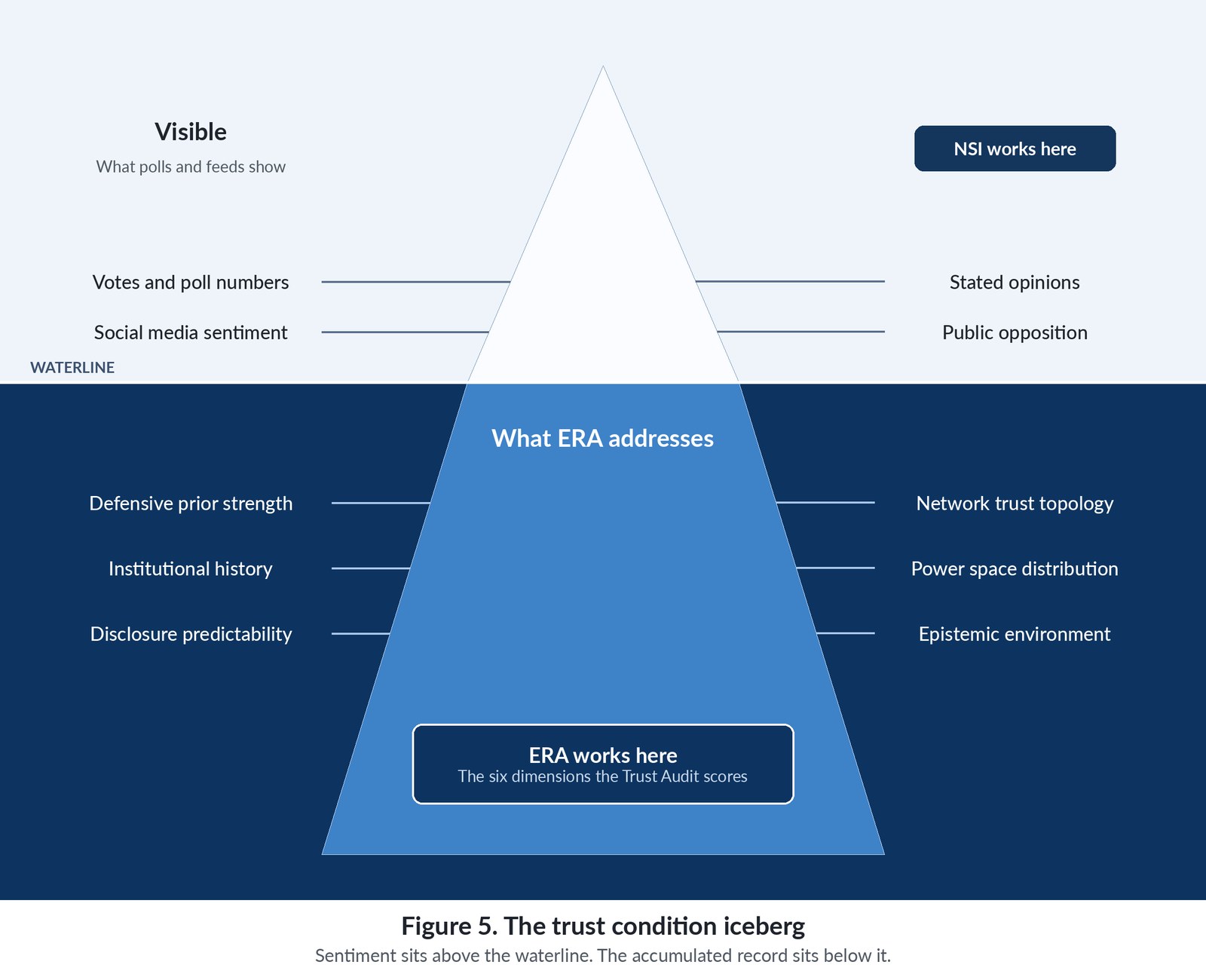
Figure 1. What was measured sat above the waterline. The trust condition sat below it.
Not a different engagement. A more fully instrumented version of the one that happened.
What was absent was not differentiation but a diagnostic foundation for it. A Trust Audit before launch would have replaced estimates with evidence for each constituency: what each group had been promised and what it had experienced, whether its reservations were about the move or about the institution, and how strong its prior expectation of disappointment was. The tailoring could then have been surgical rather than sound.
And each constituency would have carried a small set of trust indicators, tracked with the same discipline as impressions. For staff, willingness to recommend the new facility to patients and peers, and a sense of ownership rather than compliance, through brief pulse surveys before, during, and after the move. For patients, the shift in primary care use from the emergency department to the clinic network, paired with utilization data the institution already collected. For media, the changing ratio of adversarial to neutral coverage over the transition. For community organizations, participation beyond the opening events and a self-reported sense of genuine inclusion rather than of serving as a backdrop. The full indicator set, covering seven constituencies including first responders and the clinic network, is part of the Links Global library.
None of this required expensive new infrastructure. It required that someone designate trust as important, write it into the scope of work, and track it.
The Lesson
Excellent work and complete work are not the same thing. This engagement was excellent. The team was professional, the deliverables were extraordinary, the client was satisfied, and leadership repeatedly said the work was making a difference. All of that is true, and none of it tells us whether trust moved.
The most important question in communications is not “what did we produce?” It is “what changed, and how will we know?” Organizations that cannot answer the second question before they specify the first are not yet commissioning communications at the level their investment deserves. Communications is not an ancillary function or a support service. It is the sustained, multilingual, multichannel dialogue through which an institution builds or erodes its relationship with every person it depends on. The newsletter is a vehicle. The mission is trust.
Practitioner takeaway. Before accepting a scope of work, ask the client to specify in writing not only the deliverables but the trust indicators they want to track. If they have never thought in those terms, that is the beginning of the most important conversation you can have with them. If they cannot answer, that is diagnostic information: not a reason to decline, but a reason to enter differently. Bring your own measurement framework. Track trust yourself if the client will not commission it. Ask for the outcome data when the work ends. And when it was never collected, name that absence clearly, not as a complaint but as a contribution to a field still learning to measure what matters most. The feeling of not knowing at the end of a successful engagement is not failure. It is the question ERA is built to answer, the next time.
Working With Links Global
Volume 2 continues with further cases from practice, developed with Links Global’s practitioner contributors. If you are commissioning communications work and want the trust dimension measured from the start, or if you have a case from your own practice history to contribute, talk with us.
Talk with Links Global about the case library
Download the case
This case is free to download and share. Please cite it as shown below.
Ownership and use
© 2026 Links Media, L.L.C. d/b/a Links Global. All rights reserved. Narrative Stewardship Infrastructure, NSI, Epistemic Re-Regulation Architecture, ERA, and the Links Global Trust Audit are proprietary frameworks of Links Global. The Links Global Case Study Library is a proprietary analytical resource of Links Global. Cases are anonymized; any resemblance in detail to a specific institution is not an identification.
You are welcome to read this case, link to it, and quote brief passages with attribution to Links Global and a link to this page. Reproducing it in whole or in substantial part, adapting it, or using its analysis, structure, or trust-indicator approach in training, consulting, publications, or derivative works requires prior written permission from Links Global. Please cite as: Links Global (2026). The Mission Was Transformational. The Measurement Wasn’t. Links Global Case Study Library, Volume 2, Case 1. www.linksglobal.org.