
Intel Vault · Case Study Library · Volume 1
The Hardening
Links Global Case Study Library, Volume 1, Case 2: Anderson County, South Carolina infrastructure sales tax, 2006, 2024 and 2025. A case from the public record.
Case 2 of Volume 1 · From the public record · Retrospective reading, not a client engagement
The result
Three defeats. No vote rose from 52.8 percent in 2024 to about 79 percent in 2025 after a better proposal.
The reading
Low to Severely Degraded trust, hardening with every attempt. ERA first, on an 18-to-24-month timeline, before any campaign.
A Note on Volume 1
Volume 1 of the Links Global Case Study Library is different in kind from Volume 2. The Volume 2 cases come from inside Links Global’s own practice. The Volume 1 cases do not. Links Global did not work on the Lewiston bond, the Anderson County referendums, or California’s Proposition 3. No member of our staff advised any of the institutions, campaigns, or opposition groups involved, and we have no inside knowledge of how decisions were made. We selected these cases because they are well documented in the public domain. The vote counts, thresholds, ballot language, official statements, and press coverage are on the record and are cited here. They have been examined from many angles, as questions of fiscal policy, electoral politics, ballot design, and local journalism. To our knowledge they have not been read through a trust-condition lens, which is what we do here with the Trust Audit, NSI, and ERA.
Two consequences follow. First, every trust-condition estimate in this case is a retrospective reading from public evidence, not the result of a Trust Audit conducted with the institution. We give ranges, not scores, and we say where the evidence is thin. Second, the people who ran these efforts had information we do not. Where we describe what a different approach would have looked like, we are describing what the framework indicates, not judging the people who did the work. We welcome corrections from anyone closer to these cases.
| Initiative | One-percent capital projects sales tax for road and bridge repair. County estimates: about $366 million over up to seven years for the 2024 ballot, and about $352 million over eight years for the 2025 version |
| Jurisdiction and dates | Anderson County, South Carolina; 2006, November 5, 2024, and November 4, 2025 |
| Approach used | Traditional communication, redesigned and simplified between attempts |
| Trust condition (estimated from public evidence) | Low to Severely Degraded, roughly 12 to 22 on the 50-point Trust Condition Index by 2025, and falling |
| Outcome | Failed three times. No vote rose from 52.8 percent (2024) to about 79 percent (2025) |
The Problem
Anderson County, population about 220,000, has roads and bridges that county leadership itself describes as in urgent disrepair. After the 2024 defeat the Anderson Observer reported that more than a third of county roads were in poor or failing condition and that a third of the county’s 162 bridges could not carry fire trucks or school buses. (Anderson Observer) The need is genuine, well documented, and largely uncontested even by opponents. The proposed answer has been the same across three attempts spanning nearly two decades: a one-cent sales tax.
What was at stake was more than one election. It was the entrenchment of a pattern: a community developing a reflexive rejection posture toward one institution’s asks, regardless of merit. That is the most expensive communications outcome there is, because it makes every future vote harder to win.
The Result
The 2006 defeat set the baseline. That version covered a broader range of projects than roads, and the concerns on record were about the mechanism and the process. Eighteen years passed. We find no documented evidence of a sustained program during those years to demonstrate reliable delivery on routine commitments or to repair credibility with the communities that had said no. (Anderson Independent Mail via Yahoo News)
In November 2024 the ballot carried two questions: a one-percent tax for up to seven years to fund an estimated $366 million in road and bridge work, and a $15 million bond to start early. The tax failed, about 47.2 percent yes to 52.8 percent no. (WSPA; scVOTES.gov; Palmetto Promise Institute) The county’s diagnosis was ballot complexity. “The complexity of the question likely led to confusion among voters,” the county administrator said. (Anderson Independent Mail via Yahoo News)
The county redesigned the ask with evident care: a six-member commission with municipal representation named more than 300 specific road and bridge projects, proceeds were limited to maintenance of existing roads, and groceries, prescriptions, and fuel were exempted. (Anderson Observer; Anderson County) On November 4, 2025, it lost 18,370 to 4,920, about 79 percent to 21 percent, on 18.9 percent turnout. (Anderson Observer)
Two things should be said plainly. The 2024 vote came in a presidential election with roughly 84,000 ballots cast on the question; the 2025 vote was an off-year election with 23,392 participating, and low-turnout elections favor the motivated side. And the opposition was organized: the county Republican Party formally condemned the tax, and the Observer described a loosely organized campaign against it. (Anderson Independent Mail via Yahoo News; Anderson Observer) Neither point rescues the message-clarity explanation. Roughly 40,000 people voted yes in 2024 and roughly 44,000 voted no. (Anderson Observer) In 2025 the no side kept about two in five of its voters. The yes side kept about one in eight. A materially better proposal built no constituency motivated enough to show up for it. The people who might have been persuaded were not opposed. They were absent.
The most revealing data point is not the 2025 margin. It is the trajectory: defeat, defeat at 53 percent, defeat at 79 percent after a better proposal. No improvement in messaging produces that pattern. Only a deepening institutional trust deficit does. The community was no longer evaluating the proposal. It was evaluating the institution, and the decision had been made before the ballots were printed.
[ THREE_BALLOTS ] Anderson County, South Carolina
2006
Broader project list. Vote share not stated on this page.
November 5, 2024
One-percent tax, about $366 million. Two ballot questions.
November 4, 2025
Redesigned ask, about $352 million over eight years.
Between 2024 and 2025 the county redesigned the ask: a six-member commission with municipal representation, more than 300 named road and bridge projects, proceeds limited to maintenance of existing roads, and groceries, prescriptions and fuel exempted. The no vote rose anyway. The 2025 figure is approximate. Intervals between ballots are not drawn to time: 18 years separate the first and second.
The Solution
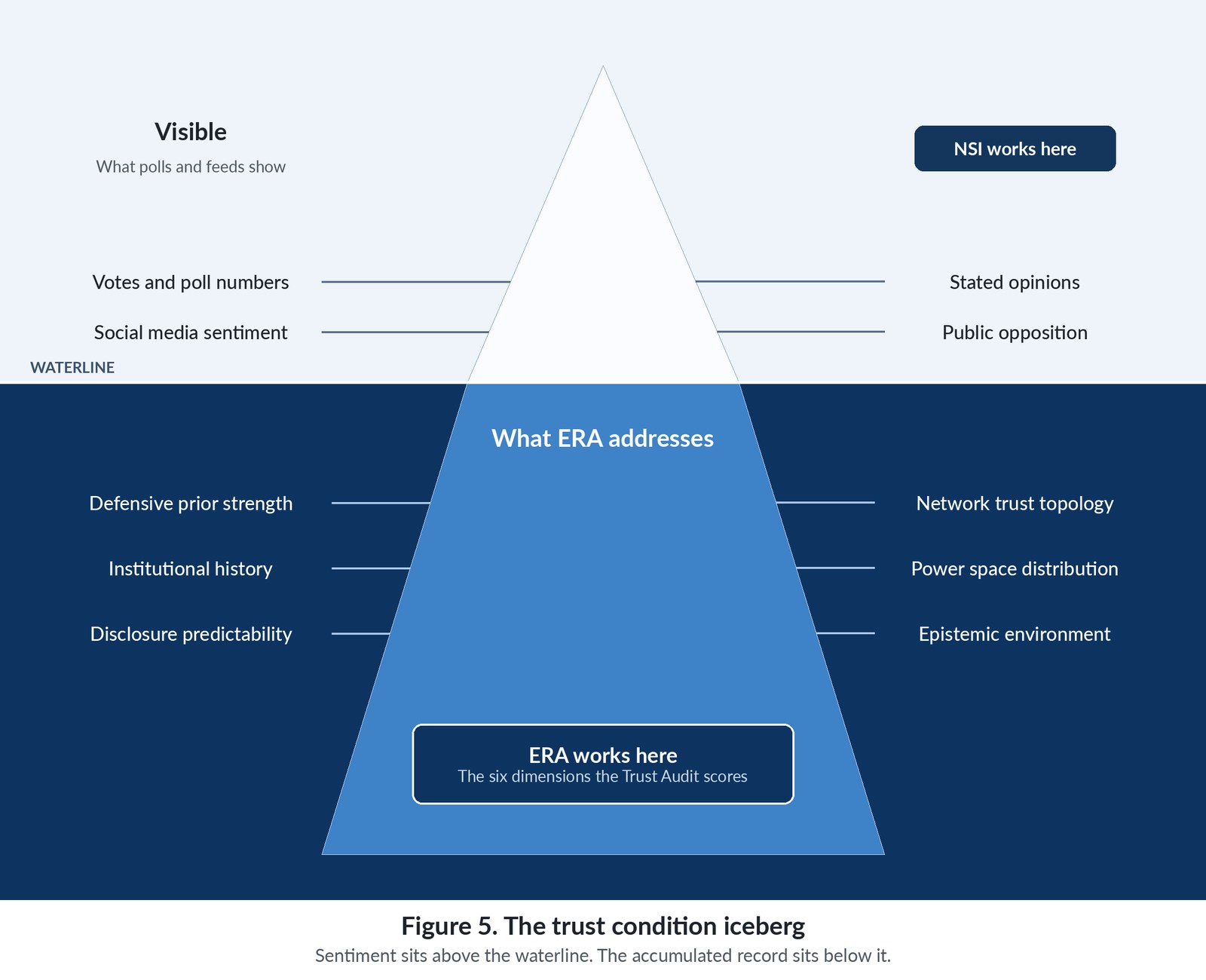
A Trust Audit before the 2024 attempt would have placed Anderson County in the Low to Severely Degraded band and would have asked the questions the county’s post-mortem did not: what did the county’s delivery record look like between 2006 and 2024, had opposition shifted from the issue to the institution, and was the community evaluating the proposal or the county?
Here NSI is contraindicated as the primary framework. A better-segmented, better-messaged, better-resourced campaign produces results consistent with the existing pattern: marginal improvement at best, further hardening at worst. The prescription is ERA, on an extended timeline, before any further referendum.
That is not a campaign. It is an 18-to-24-month program of institutional behavior change: a public commitment ledger for routine county operations, tracked and acknowledged when missed, so the county demonstrates through unremarkable consistency that it does what it says; a disclosure calendar for every capital project undertaken in the meantime; an independent citizens’ oversight body with real authority over any future fund allocation plan, attached years before the ballot rather than months, and built to hold the county to account afterward rather than to write the question; and genuine relationships with the credibility hubs in the communities and networks that voted no most strongly, so that the county’s actual record can be independently assessed. Only when those mechanisms are producing a measurable improvement in the trust condition should a next attempt be considered. On the present evidence, a fourth attempt run as a better campaign would be a fourth defeat.
The Lesson
Opposition that intensifies across redesigned proposals is not a message problem. It is a trust-condition problem. Applying better message design to a trust-condition problem does not close the gap. It widens it, because each failed attempt deepens the very expectation of institutional futility that is driving the rejection.
Practitioner takeaway. If you have run a similar initiative before and lost, and opposition intensified despite a better proposal, stop designing a better campaign. Start asking why better campaigns are producing worse outcomes. The answer is almost always in what the institution has done and not done with this community in the years between attempts. The intervention that follows is not a communications campaign. It is institutional behavior change, sustained over time, before anyone asks for anything.
Sources
- Travis Jacque Rose, “Anderson County voters to decide fate of penny sales tax to be used to fix roads, bridges,” Anderson Independent Mail via Yahoo News, November 4, 2025. yahoo.com
- “Voters Reject Roads Referendum,” The Anderson Observer, November 5, 2025. andersonobserver.com
- “Voters Reject One-Cent Tax to Fix Roads,” The Anderson Observer, November 2024. andersonobserver.com
- “2024 Marks New Efforts, Storms, Updates in County” and “2025 a Year of Progress, but Much Left to Be Done in Anderson County,” The Anderson Observer. andersonobserver.com; andersonobserver.com
- Anderson County Transportation Sales Tax, referendum detail, November 5, 2024. scVOTES.gov
- “Complete 2024 South Carolina Election Results and Analysis,” Palmetto Promise Institute. palmettopromise.org
- Capital Projects Sales Tax Commission, Anderson County government. andersoncountysc.org
All figures in this case are drawn from the public record cited above. The 2025 vote counts are the election-night figures reported by the Anderson Observer; certified totals differ by a few votes. The trust-condition estimate and the NSI/ERA reading are Links Global’s analysis.
Working With Links Global
This case is one of three in Volume 1, alongside The Majority That Wasn’t Enough (Lewiston, Idaho) and The Process Problem (California Proposition 3). The three sit at different points on the trust spectrum and call for different responses, which is the point of the library: the failures were not failures of effort or talent, they were failures of diagnosis. The Trust Condition Framework explains how the Trust Audit, NSI, and ERA fit together, and the Trust Audit Practitioner Course teaches the cases in sequence. If your institution has lost the same vote more than once, this is the case to read closely, and we are glad to talk it through.
Talk with Links Global about the case library
Copyright and Use
You are welcome to read this case, link to it, and quote brief passages with attribution to Links Global and a link to this page. Reproducing it in whole or in substantial part, adapting it, translating it, or using its analysis, structure, or framework reading in training, consulting, publications, or derivative works requires prior written permission from Links Global. Academic citation is encouraged; please cite as: Links Global (2026). The Hardening: Anderson County, South Carolina Infrastructure Tax (2006, 2024, 2025). Links Global Case Study Library, Volume 1, Case 2. www.linksglobal.org.