
Intel Vault · Case Study Library · Volume 2
The Work Was Excellent. The Structure Made It Impossible to Use.
Links Global Case Study Library, Volume 2, Case 2: communications in a multi-partner regional health initiative, anonymized.
Case 2 of Volume 2 · Anonymized by sector and year
The problem · The results · What we would add now · The lesson
By contract
Exceeded across two contract periods and eight years. Contract renewed.
By our assessment
Structurally limited. The consortium’s internal trust condition and a product-delivery scope prevented the work the program needed.
A Links Global case study from practice. Volume 2 cases are drawn from Links Global’s practice history since 2002, anonymized by sector and year. No client, organization, or individual is identified.
A Note on Volume 2
Volume 1 drew on the public record. Volume 2 cases come from inside the work: engagements where the program was professionally executed, the metrics were met, and the contract was renewed, and where something essential was still not served. They are offered as diagnostic opportunities. Applied in retrospect, the Trust Audit, NSI, and ERA clarify what was happening structurally. This case is about a structure.
| Initiative | Multi-year communications program embedded in a federally funded, multi-partner regional initiative to control a vector-borne disease across more than a dozen countries in Latin America and the Caribbean |
| Sector and period | International public health, grant-funded consortium; about eight years across two contract periods, mid-2000s to early 2010s |
| Approach used | Traditional communication, comprehensively and professionally executed |
| Trust condition (estimated in retrospect) | Two environments. Inside the consortium: severely degraded (roughly 8 to 15 on the 50-point index). With target communities: low to damaged (roughly 16 to 28). No formal Trust Audit was conducted |
| Outcome by contract | Exceeded across both periods. Contract renewed. Every deliverable met and surpassed |
| Outcome by our assessment | Structurally limited. The most consequential communications work was prevented by the procurement architecture and the consortium’s internal trust failure |
The Problem
The initiative brought together some of the most technically credentialed institutions in international public health, a regional multilateral health body, two federal agencies, a pharmaceutical standards organization, a health management sciences group, and a specialized public health communications firm, to reduce the burden of a disease that was real, consequential, and underestimated. Mortality in the region was lower than elsewhere in the world, but the burden was measured in repeated illness cycles, economic paralysis, and the marginalization of the populations most affected: indigenous communities, informal miners, agricultural workers, people living where environmental vulnerability meets institutional neglect.
Two trust conditions shaped the engagement, and the more consequential one was internal.
Externally, the disease carried a specific history. Mid-twentieth-century “eradication” campaigns had achieved elimination where resources were sustained and catastrophic resurgence where they were withdrawn. Communities had watched that cycle. Their skepticism toward any externally funded initiative was not irrational; it was empirically grounded. A Trust Audit would have read institution-specific skepticism rooted in prior program withdrawal, communities positioned as recipients rather than collaborators, and an information environment shaped by decades of conflicting health messaging.
Internally, the consortium had not built the conditions for collaboration before the work began. Partners had different institutional cultures, professional languages, incentives, and implicit hierarchies of expertise. The dominant technical partner treated communication as a support function: useful for documentation and visibility, subordinate to the scientific work it considered its core mandate. That position was never written into the scope. It was expressed in behavior, in meetings, in budget negotiations, in how the firm’s proposals were received. Power was concentrated without accountability, communications expertise was positioned below its value, and every partner’s incentives pointed toward demonstrating the preeminence of its own contribution rather than toward integration.
The Solution
Despite those constraints, the firm produced an extraordinary and verifiable body of work across eight years. It wrote the initiative’s flagship multi-year goals and accomplishments report, synthesizing technical achievements across every partner domain for policymakers, funders, and regional stakeholders. It produced annual reports, fact sheets, success stories, and lessons-learned documents that translated epidemiological and pharmaceutical findings into accessible language. It produced patient education materials in multiple languages, including a rapid diagnostic test manual designed for community health workers with limited formal education in remote areas. It managed earned media in the United States and across the region, developed training and ran workshops, documented events including the initiative’s tenth anniversary, and built a social media network of more than 600 members at a time when that was a real achievement for a technical health network.
Two contributions matter most to this case because of how they were received. The firm conceived and championed an online clearinghouse, a knowledge repository that organized the initiative’s accumulated evidence base. Technical partners initially dismissed it as outside the scope of communications. It became one of the initiative’s most durable contributions to regional knowledge management. The firm also developed peer-reviewed manuscript content and secured a Wikipedia article for the initiative, navigating that platform’s notability and neutrality rules to create a permanent public reference. Partners dismissed that too, and later did not acknowledge it as a communications contribution.
The Results
By every contracted metric, the engagement succeeded: deliverables, timelines, placements, events, materials, trainings, all measured rigorously and exceeded, across two contract periods.
What was not measured was whether target communities’ trust in the initiative shifted, whether health workers’ confidence in the diagnostic protocols improved durably, or whether the consortium’s internal working relationships became more functional over time. Both trust conditions were measurable. Neither was measured.
And the structure had a human cost, which is rarely named and belongs in the record. Working for years in an environment where professional expertise is systematically dismissed, where proposals meet ridicule rather than engagement, and where institutional power is exercised without accountability takes a specific and serious toll. It fell on real people with genuine commitment to the populations the initiative served. It affected the quality of the work, the sustainability of the team, and the professional and personal health of the firm’s leadership in ways that outlasted the contract. Those costs are borne disproportionately by the smallest, most specialized, least powerful partners in a consortium, and they appear in no scope of work, budget, or evaluation framework.
Postscript
The initiative ran for about a decade and produced genuine technical achievements: cross-border pharmaceutical quality networks, standardized diagnostic protocols, drug resistance surveillance, and the human capacity to sustain them. The region saw significant reductions in cases and deaths while it was active. When the funding ended, the regional networks lost the coordination infrastructure that had held them together. Surveillance fragmented. Supply chains strained. A decade of capacity was exposed to the same abandonment that had produced resurgence in the twentieth century.
The sobering finding is this. The communications work most dismissed by technical partners, the clearinghouse, the public reference article, the policy-facing media, was precisely the work designed to make the evidence base durable and independent of any single funding stream. The work most valued depended entirely on the funding that was withdrawn.
[ TRUST_CONDITION_MAP ] Two environments, estimated in retrospect
No formal Trust Audit was conducted. Both trust conditions were measurable. Neither was measured.
View the ranges as a table
| Environment | Estimated range (of 50) |
|---|---|
| Inside the consortium | 8 to 15 |
| With target communities | 16 to 28 |
What We Would Add Now
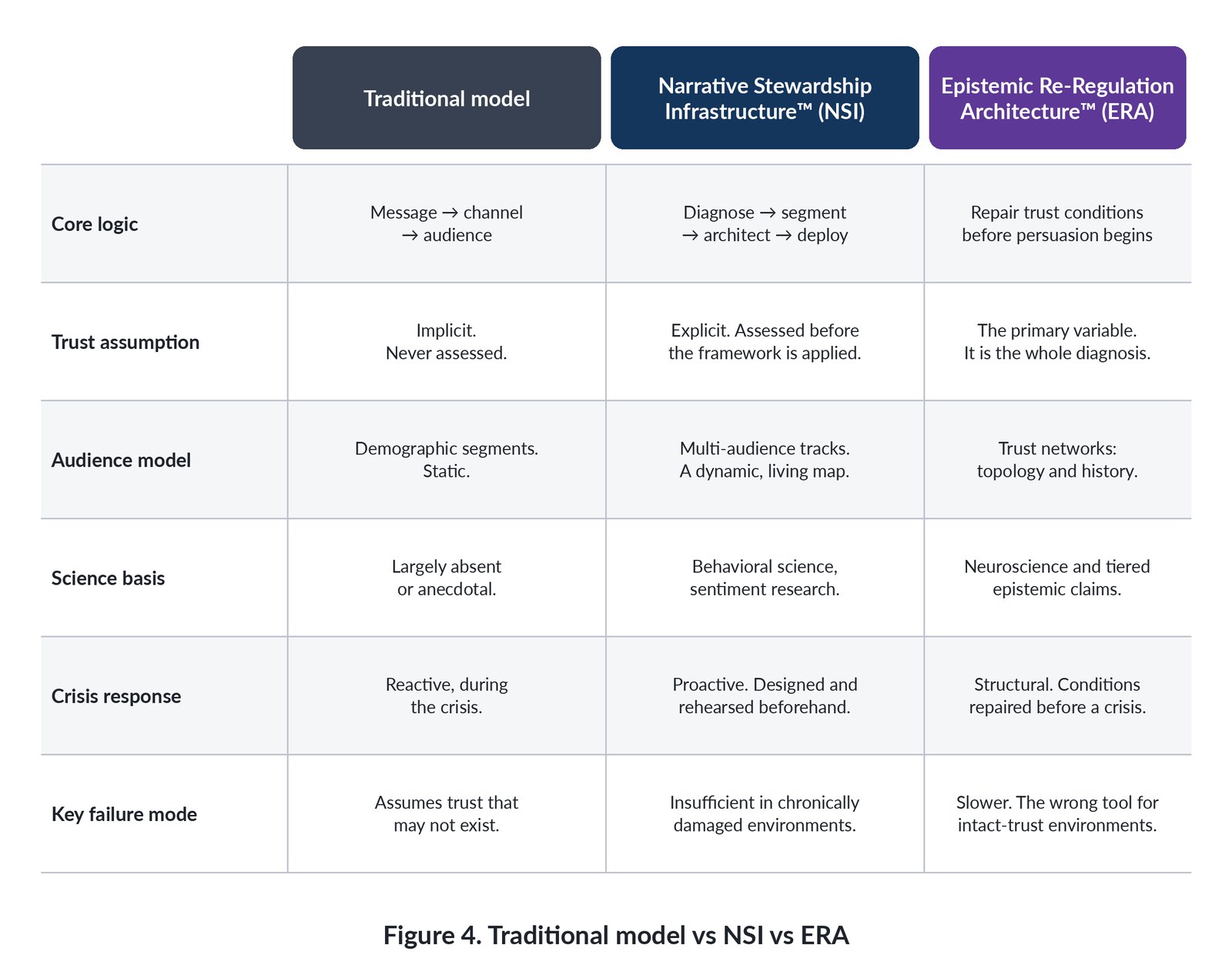
Figure 1. Traditional communication, NSI, and ERA compared. The engagement was procured as the first column.
Inside the consortium, the indicated ERA intervention was predictability-first disclosure applied to the partnership itself: an agreement, before the work began, about how decisions would be made, how disputes would be resolved, and how each partner’s expertise would be recognized and integrated. That agreement did not exist, and its absence produced the marginalization that defined the engagement.
With target communities, the indicated intervention was shared experience: genuine, consequential participation by affected communities in the design of the communication program, not just in receiving its products. That was not available inside a product-delivery scope of work.
NSI’s audience architecture was partly applied; products were differentiated by audience, language, and channel. But without predictive insight integration and without the programmatic authority to adjust strategy on real feedback, differentiation produced better products rather than better outcomes. Trust indicators for communities, frontline health workers, ministries, funders, the consortium partners themselves, and regional media would have made the difference legible; the full set is part of the Links Global library.
The Lesson
A communications firm that delivers everything the scope specifies, while being prevented from doing the work the program actually needs, has not failed. The program has.
The conditions that produce this outcome are not individual failures. They are systemic features of how communications is procured in multi-partner initiatives: product-delivery scopes, consortium hierarchies that marginalize communications expertise, and evaluation frameworks that count activities rather than outcomes. They produce predictable, recurring, expensive failures, not because the technical work or the communications work is bad, but because the framework connecting them treats communications as a downstream service rather than as the condition that determines whether technical work changes anything.
Practitioner takeaway. Before entering a multi-partner engagement, diagnose the consortium itself. Does its technical leadership understand what communications work is designed to produce? Is there a mechanism for communications strategy to influence programmatic decisions, or is it positioned downstream of them? Are accountability frameworks built on outcomes or on activities? Does the culture carry a prior expectation that communications is a support function, and if so, can that be challenged contractually? If the answers reveal a damaged internal trust condition, the most important work before signing is not the proposal. It is negotiating the working conditions that will determine whether excellent work can be used. A firm that enters without that negotiation may still produce excellent work, at enormous cost to the firm, the team, and the populations the program was meant to serve.
Working With Links Global
Volume 2 continues with further cases from practice, developed with Links Global’s practitioner contributors. If you are designing or joining a multi-partner initiative and want the trust conditions, internal and external, diagnosed before the work begins, or if you have a case from your own practice to contribute, talk with us.
Talk with Links Global about the case library
Download the case
This case is free to download and share. Please cite it as shown below.
Ownership and use
© 2026 Links Media, L.L.C. d/b/a Links Global. All rights reserved. Narrative Stewardship Infrastructure, NSI, Epistemic Re-Regulation Architecture, ERA, and the Links Global Trust Audit are proprietary frameworks of Links Global. The Links Global Case Study Library is a proprietary analytical resource of Links Global. Cases are anonymized; any resemblance in detail to a specific institution is not an identification.
You are welcome to read this case, link to it, and quote brief passages with attribution to Links Global and a link to this page. Reproducing it in whole or in substantial part, adapting it, or using its analysis, structure, or trust-indicator approach in training, consulting, publications, or derivative works requires prior written permission from Links Global. Please cite as: Links Global (2026). The Work Was Excellent. The Structure Made It Impossible to Use. Links Global Case Study Library, Volume 2, Case 2. www.linksglobal.org.