
Intel Vault · Case Study Library · Volume 1
The Process Problem
Links Global Case Study Library, Volume 1, Case 3: California Proposition 3, water infrastructure bond, November 2018. A case from the public record.
Case 3 of Volume 1 · From the public record · Retrospective reading, not a client engagement
The result
49.35 percent yes to 50.65 percent no. The opposition registered no committee and spent nothing.
The reading
Moderate trust, one verification gap built into the product. NSI, plus independent verification attached before the ballot.
A Note on Volume 1
Volume 1 of the Links Global Case Study Library is different in kind from Volume 2. The Volume 2 cases come from inside Links Global’s own practice. The Volume 1 cases do not. Links Global did not work on the Lewiston bond, the Anderson County referendums, or California’s Proposition 3. No member of our staff advised any of the institutions, campaigns, or opposition groups involved, and we have no inside knowledge of how decisions were made. We selected these cases because they are well documented in the public domain. The vote counts, thresholds, ballot language, official statements, and press coverage are on the record and are cited here. They have been examined from many angles, as questions of fiscal policy, electoral politics, ballot design, and local journalism. To our knowledge they have not been read through a trust-condition lens, which is what we do here with the Trust Audit, NSI, and ERA.
Two consequences follow. First, every trust-condition estimate in this case is a retrospective reading from public evidence, not the result of a Trust Audit conducted with the institution. We give ranges, not scores, and we say where the evidence is thin. Second, the people who ran these efforts had information we do not. Where we describe what a different approach would have looked like, we are describing what the framework indicates, not judging the people who did the work. We welcome corrections from anyone closer to these cases.
| Initiative | $8.877 billion general obligation bond for safe drinking water, watershed restoration, groundwater sustainability, fish and wildlife habitat, and flood protection |
| Jurisdiction and date | State of California; November 6, 2018 |
| Approach used | Traditional communication with social marketing elements: coalition building, endorsements, voter targeting, need-based messaging |
| Trust condition (estimated from public evidence) | Moderate overall, roughly 28 to 36 on the 50-point Trust Condition Index, with institution-specific opposition concentrated on the drafting process |
| Outcome | Failed. 5,879,836 yes (49.35 percent) to 6,034,991 no (50.65 percent) |
The Problem
California’s water needs are among the most documented in the country, and the state has a record of saying yes to water bonds. Proposition 1, a $7.1 billion legislative bond, passed in 2014 with 67 percent. Proposition 68, a $4 billion legislative bond, passed in June 2018 with 57.59 percent. (Ballotpedia) Almost no serious voice argued against water investment in principle.
Proposition 3 carried one specific vulnerability. Unlike the two bonds before it, it did not come through the Legislature. It was a citizen initiative, qualified for the ballot by a campaign that raised $4.94 million, much of it from organizations that stood to receive bond funds, and its allocations were negotiated outside public view, including $750 million for the Tulare, Kings, and Fresno area. (Ballotpedia; California WaterBlog) For most of the electorate the trust condition was intact. The problem was concentrated in a single variable: the legitimacy of the process that packaged the ask.
The Result
The bond fell about two-thirds of a point short of a majority. (Ballotpedia) The opposition’s most effective framing was not invented. Editorial boards at the Los Angeles Times, San Francisco Chronicle, Marin Independent Journal, and Santa Cruz Sentinel called the measure “pay-to-play,” on the specific ground that the people funding it would receive its money. Sierra Club California said it “flew in the face of good governance by being written behind the scenes,” and the Assembly Speaker cited “a lack of oversight and a surplus of special interest projects.” The League of Women Voters of California and Friends of the River also opposed it. (Ballotpedia; California WaterBlog)
The defection was geographic and it tracked the process concern. Among the twenty most Democratic-leaning counties, which had carried both earlier bonds, support ran 11.5 points below Proposition 68 a few months earlier. Marin, Mendocino, Solano, and Sacramento voted no. Republican-leaning Tulare and Kings, the beneficiaries of the regional earmarks, voted yes. (California WaterBlog) The counties that defected were not opposed to water investment. They were the ones most attuned to how the measure was built, and the counties that moved toward it were the ones it had paid.
Other factors were in play, and the record names them: the drought that carried Proposition 1 was over, voters had approved a $4 billion bond five months earlier, and the campaign was small for a statewide measure. Each contributed. What the process explanation accounts for, and the others do not, is the shape of the defection. Bond fatigue depresses support broadly; it does not turn Marin against a water bond while turning Tulare toward one. It is also worth noting what the opposition spent to achieve this. No committee registered against Proposition 3, and reported opposition spending was zero. (Ballotpedia) The opposition did not need a campaign. The measure’s structure was the campaign. Every message that said “California needs water infrastructure” met a specific, checkable counterclaim about which dollars went to which interest through which closed room, and the campaign’s own product made that counterclaim impossible to credibly deny. The failure point was earlier than election day. It was in the drafting room.
[ CLOSE_MARGIN ] California, November 6, 2018
Margin
Votes between yes and no
Short of a majority
About two-thirds of a point
Defection
Lower support than Proposition 68 among the twenty most Democratic-leaning counties
Drawn to scale. Yes 49.35 percent, no 50.65 percent of votes cast. Margin computed from the reported totals. Sources as cited on this page.
The Solution
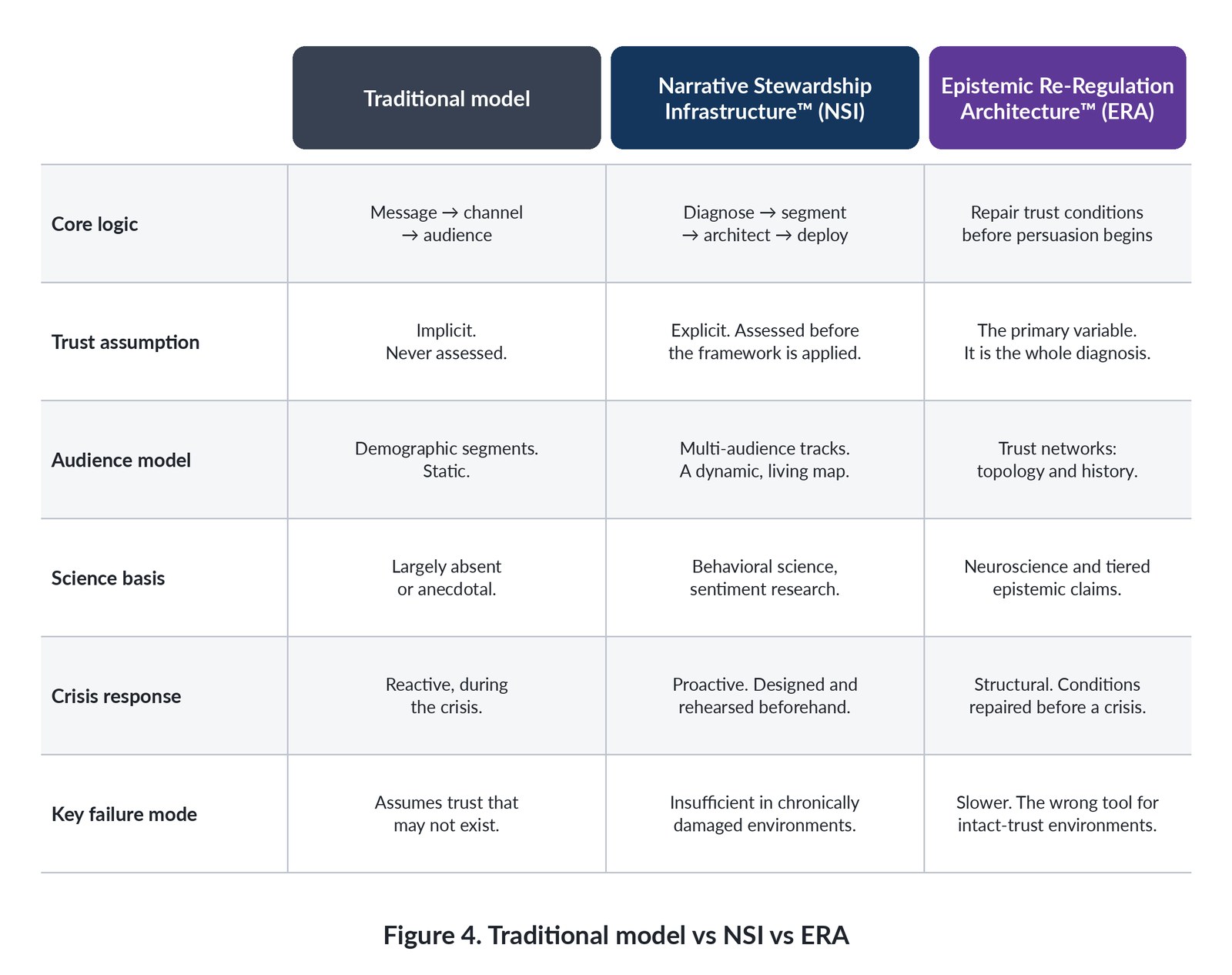
A Trust Audit before ballot qualification would have identified the drafting process as the primary perception risk: who designed this, through what process, and can a credible critic characterize the outcome as private interest at public expense using information that is already public? The answer was yes, and the recommendation follows: open the process, or attach independent verification to its outcome before the campaign begins.
NSI was the right primary framework, and a well-run NSI campaign came within two-thirds of a point. The missing element was the ERA mechanism of pre-attached verification: an independent oversight panel with real authority to inspect the allocation formula, assess whether earmarks served the public interest, and publish its findings, including dissent, before the ballot. Present before the opposition narrative formed, that structure changes the evidentiary ground on which “pay-to-play” stands. Combined with NSI audience architecture across California’s regional constituencies, with particular attention to the historically supportive counties showing defection risk, the margin closes because the withholding minority receives a credible answer to its specific concern. Those counties were not asking for a better message. They were asking for a reason to believe the process.
The Lesson
A bond’s governance structure is a communications asset or a liability before the campaign begins. A measure drafted through a closed process by a coalition of beneficiaries hands the opposition its material before a single campaign dollar is spent. The correct intervention is not a better response to the “pay-to-play” narrative. It is a structure that makes the narrative non-credible before it forms.
Practitioner takeaway. Before any major referendum, examine the process that produced the initiative. Who designed it, how, and can a motivated critic fairly characterize that process as serving private interests using public information? If yes, the problem is in the product, not the campaign. Restructure the process or attach independent, falsifiable verification to its outcome before launch. No campaign communication can retroactively supply the verification a transparent process would have provided.
Sources
- “California Proposition 3, Water Infrastructure and Watershed Conservation Bond Initiative (2018),” Ballotpedia. ballotpedia.org
- “California Proposition 68, Parks, Environment, and Water Bond (June 2018),” Ballotpedia. ballotpedia.org
- Cassidy Craford and Hannah Safford, “When do water bonds pass? Lessons from past elections,” California WaterBlog, UC Davis Center for Watershed Sciences, April 14, 2019. californiawaterblog.com
All figures in this case are drawn from the public record cited above. The trust-condition estimate and the NSI/ERA reading are Links Global’s analysis.
Working With Links Global
This case is one of three in Volume 1, alongside The Majority That Wasn’t Enough (Lewiston, Idaho) and The Hardening (Anderson County, South Carolina). The three sit at different points on the trust spectrum and call for different responses, which is the point of the library: the failures were not failures of effort or talent, they were failures of diagnosis. The Trust Condition Framework explains how the Trust Audit, NSI, and ERA fit together, and the Trust Audit Practitioner Course teaches the cases in sequence. If the measure you are preparing was built in a closed room, this is the case to read before the campaign is designed, and we are glad to talk it through.
Talk with Links Global about the case library
Copyright and Use
You are welcome to read this case, link to it, and quote brief passages with attribution to Links Global and a link to this page. Reproducing it in whole or in substantial part, adapting it, translating it, or using its analysis, structure, or framework reading in training, consulting, publications, or derivative works requires prior written permission from Links Global. Academic citation is encouraged; please cite as: Links Global (2026). The Process Problem: California Proposition 3, Water Infrastructure Bond (2018). Links Global Case Study Library, Volume 1, Case 3. www.linksglobal.org.